The AI engineering job market has fundamentally repriced in the last 18 months. Roles requiring AI skills now carry a 56% wage premium over comparable non-AI positions — up from 25% just a year ago. The average base salary across AI engineering roles with disclosed compensation hit $206,000 in mid-2026, a $50,000 increase year-over-year.
This guide breaks down what AI engineering roles actually pay in 2026 — by role, level, specialisation, and location — using data from active job listings, not surveys or self-reported data.
Salary by Role: The Full Picture
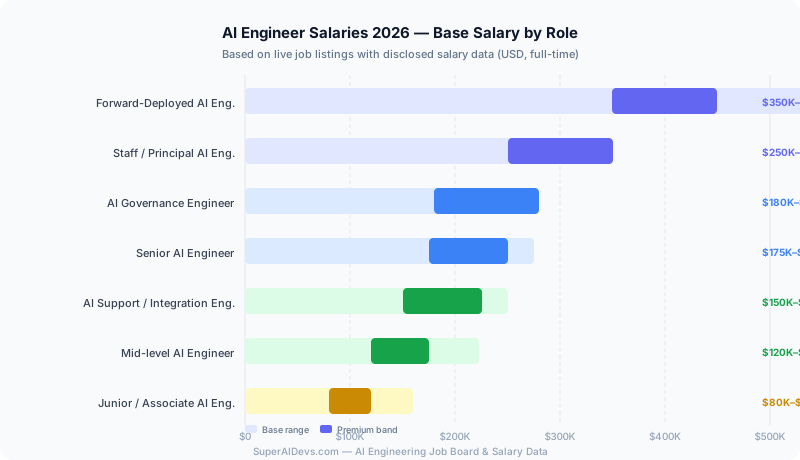
| Role | Mid-level | Senior | Staff / Principal | |------|-----------|--------|-------------------| | Forward-Deployed AI Engineer | $180K–$250K | $250K–$350K | $350K–$450K | | AI Governance / Ethics Engineer | $150K–$220K | $200K–$280K | $260K–$380K | | Staff / Principal AI Engineer | — | $220K–$300K | $280K–$400K | | AI Platform / MLOps Engineer | $140K–$190K | $180K–$250K | $240K–$320K | | Senior AI Engineer (general) | $150K–$200K | $175K–$250K | $220K–$300K | | AI Support / Integration Engineer | $120K–$160K | $150K–$200K | $180K–$250K | | Junior / Associate AI Engineer | $80K–$120K | — | — |
These are base salary ranges from listings with disclosed compensation. Total compensation (base + equity + bonus) typically runs 40–120% higher at pre-IPO companies and 20–50% higher at public tech companies.
The Highest-Paying Specialisations in 2026
Across all AI engineering roles, certain specialisations command a consistent premium above the role median:
1. Forward-Deployed / Solutions Engineering ($350K–$450K) The highest-paying AI engineering track. You're responsible for making AI work inside enterprise customers' environments — integrating with their systems, owning the deployment outcome, and managing technical relationships with clients. The premium reflects both the technical skill and the client-facing accountability. Postings for this role grew 800% in 2025.
2. AI Governance and Compliance ($180K–$320K) The fastest-growing role category — 1,257% posting growth in 2025. Companies navigating the EU AI Act, NIST AI RMF, and emerging US federal AI regulation need engineers who understand both the technical systems and the regulatory requirements. Scarce skill set, high demand, rapidly rising compensation.
3. AI Evaluation / Reliability Engineering ($160K–$280K) Running evals, maintaining quality in production AI systems, and owning the feedback loop between production behaviour and model/prompt improvements. A relatively new specialisation that's becoming a standalone discipline at companies with mature AI products.
4. RAG / Retrieval Engineering ($150K–$250K senior) Engineers who can design, build, and maintain production RAG systems — with specific depth in chunking strategies, hybrid retrieval, re-ranking, and quality measurement — command a consistent premium above generalist AI engineers. The gap between "can build a RAG demo" and "can run a RAG system reliably at scale" is where the compensation premium lives.
5. Agent / Orchestration Engineering ($160K–$260K senior) Building multi-step agent systems with LangGraph or similar frameworks that operate reliably under real-world conditions. The premium here is about production reliability of non-deterministic systems — a genuinely hard problem most engineers haven't solved.
Salary by Location and Work Model
Fully remote roles trend toward the top of the salary range for each role. Remote AI engineering jobs routinely offer 10–15% above the equivalent on-site role at the same level, because companies are competing for a global talent pool rather than a local one.
Location premium / discount by metro:
| Location type | Adjustment vs. median | |---------------|----------------------| | San Francisco / Bay Area | +20–35% | | New York City | +15–25% | | Seattle / Boston | +10–20% | | Austin / Denver / Atlanta | -5–10% | | Non-coastal US cities | -10–20% | | Remote (US-based) | +10–15% | | Remote (international) | -20–40% |
Bay Area roles still carry the largest premium — particularly at AI-native companies where equity value can dramatically exceed the base salary differential. An engineer choosing between a $200K Bay Area role at a well-funded AI startup and a $185K remote role at a public company may find the startup option worth significantly more in total five-year value if the company performs.
Experience Level Benchmarks
0–2 years (Junior / Associate AI Engineer): $80K–$120K Typically recent graduates or engineers transitioning from adjacent roles (data analyst, software engineer with minimal AI exposure). Expected to contribute to existing AI systems under senior guidance. The lower end applies to roles outside major tech markets or at companies outside the core AI industry.
2–4 years (Mid-level AI Engineer): $120K–$175K Can independently build and deploy LLM integrations. Has production experience with at least one of: RAG pipelines, agent frameworks, model fine-tuning, or AI evaluation. At this level, demonstrated production experience becomes the primary salary driver — someone with 2 years of production AI experience typically earns more than someone with 4 years of AI-adjacent experience.
4–7 years (Senior AI Engineer): $175K–$250K Owns complex AI systems end-to-end. Can make sound architectural decisions, build evaluation frameworks, and mentor junior engineers. Understands cost optimisation, latency management, and the operational requirements of AI in production.
7+ years (Staff / Principal AI Engineer): $250K–$400K+ Sets technical direction, solves the organisation's hardest AI problems, and has significant influence on the product and engineering roadmap. At this level, role scope and company stage matter more than years of experience — a "Staff Engineer" at a 20-person AI startup is a different job than the same title at a 10,000-person tech company.
Contract and Freelance Rates
The AI engineering contract market has been active, with companies using contractors to bridge hiring gaps while they find permanent engineers.
| Role / Specialisation | Hourly rate | |----------------------|------------| | Senior AI engineer (generalist) | $100–$175/hr | | RAG / retrieval specialist | $125–$200/hr | | AI governance consultant | $150–$250/hr | | Forward-deployed / solutions | $175–$300/hr | | AI evaluation specialist | $100–$175/hr | | MLOps / AI platform engineer | $90–$150/hr |
Day rates typically apply a 10–20% discount to the hourly equivalent due to guaranteed daily utilisation. Statement-of-work project pricing varies significantly by scope.
What Drives Salary Above the Range
Within any given role and level, these factors consistently push compensation toward the top of the range:
Production scale. Have you operated AI systems serving hundreds of thousands of users, or just a few thousand? The infrastructure, reliability, and cost optimisation challenges at scale are significantly harder, and companies pay for demonstrated experience at that scale.
Evaluation depth. Engineers who have built serious eval frameworks — not just "I used an LLM-as-judge setup," but genuinely rigorous measurement systems with baselines, regression detection, and continuous monitoring — are scarce and paid accordingly.
Specific regulatory experience. For AI governance roles: demonstrated experience navigating a specific regulatory framework (EU AI Act, HIPAA for AI in healthcare, financial services AI regulations) in a production context is worth 20–30% above the base range.
Open source contributions. Contributors to major AI open source projects (LangChain, LlamaIndex, Instructor, Haystack, Marvin) consistently command above-median offers, because companies see the evidence of their skills before the interview.
The combination of technical + communication skill. This is particularly relevant for forward-deployed and solutions engineering roles: engineers who can both ship production code and communicate clearly with non-technical stakeholders are genuinely rare, and companies that need this combination know it.
The Equity Question
At pre-IPO AI companies, equity can be worth dramatically more than the base salary over a 4-year vesting period. The AI companies that raised at significant valuations in 2023–2025 — and are now generating real enterprise revenue — represent meaningful equity opportunity for engineers who joined at the right time.
Evaluating AI company equity requires thinking about:
- Company valuation at your grant date vs. the last funding round valuation
- Preference stack: how many liquidation preferences sit above common stock?
- Secondary market activity: is there an active secondary market suggesting real liquidity potential?
- Revenue trajectory: is the company on a path where an IPO or acquisition in the next 3–5 years is plausible?
A $200K base + $150K/yr equity grant at a well-positioned AI company may be worth significantly more than a $280K base at a public company with minimal equity upside. The math is company-specific and requires real due diligence.
What the Market Looks Like in Mid-2026
Demand for AI engineers continues to exceed supply by an estimated 30–40%, and this gap is expected to widen through 2027. This structural imbalance has three practical implications:
Interview processes are shortening. Companies that used to run 6–8 round interviews are down to 3–4 for AI engineering roles because candidates are receiving multiple offers and making decisions quickly. If you're actively interviewing, expect faster timelines than you've experienced before.
Counter-offers are common. Engineers at mid-to-senior level with demonstrated AI production experience are routinely receiving counter-offers when they signal they're leaving. Factor this into your negotiation strategy.
The salary floor is rising faster than the ceiling. The biggest salary growth is happening at the mid-level, where the market has recognised that competent AI engineers are scarcer than previously assumed. If you've been in an AI engineering role for 2–4 years, you may be meaningfully underpaid relative to the current market.
If you're exploring AI engineering roles or benchmarking your compensation, browse current listings on SuperAIDevs with salary filtering — every listing shows the disclosed range so you can compare your current comp to what the market is offering.