While everyone has been chasing LLM engineer and prompt engineer roles, one AI job category grew 1,257% in posting volume between 2024 and 2026. AI governance engineers — the people responsible for making sure AI systems are safe, compliant, and accountable — are now among the most sought-after and least-supplied specialists in the entire AI labour market.
The role has been propelled by a specific combination of forces: the EU AI Act (the world's first comprehensive AI regulation, now in force), the NIST AI Risk Management Framework becoming a contractual requirement for US federal AI vendors, and a wave of enterprise AI deployments that are now hitting the scrutiny of legal, compliance, and board-level review.
This guide covers what the role actually involves, what it pays, what skills it requires, and how to get in before the market fully catches up.
Why This Role Exists Now
Three years ago, "AI ethics" was a research discipline at academic institutions and a marketing function at large tech companies. Something changed in 2024.
The EU AI Act became law. Effective August 2024, with compliance deadlines rolling out through 2026, the EU AI Act created legal requirements for companies deploying AI in the EU market. High-risk AI systems (those affecting employment decisions, credit scoring, healthcare, law enforcement) require conformity assessments, technical documentation, human oversight mechanisms, and ongoing monitoring. Companies need engineers who can implement these requirements in actual production systems.
The NIST AI RMF became a procurement requirement. US federal agencies and their contractors are increasingly required to demonstrate compliance with the NIST AI Risk Management Framework. This has cascaded into enterprise procurement requirements — Fortune 500 companies are now asking their AI vendors to demonstrate governance practices before signing contracts.
Enterprise AI deployments are now facing board-level scrutiny. After a wave of early AI deployments that produced hallucinations, biased outputs, and compliance failures, boards are asking harder questions. The demand for engineers who can build the systems that answer those questions has followed.
What an AI Governance Engineer Actually Does
The role sits at the intersection of engineering, legal/compliance, and product. A typical week might involve:
Risk assessment for a new AI feature A product team wants to add an AI-powered hiring screener. You're the engineer who evaluates the risk: What are the potential failure modes? Is this a high-risk AI system under the EU AI Act? What bias testing needs to happen before it ships? What human oversight mechanisms need to be built in? You produce a structured risk assessment that feeds into the go/no-go decision.
Building the compliance monitoring pipeline You're implementing the system that checks whether the company's deployed AI systems are behaving consistently with their documented purpose, accuracy claims, and safety constraints. This involves LLM-based output monitoring, structured logging, statistical anomaly detection, and alerting. It's engineering work, not policy work — you're building the infrastructure that makes ongoing compliance possible.
Running bias and fairness evaluations A deployed recruitment AI is flagging for review. You run the audit: does the model perform differently across demographic groups? Are there systematic patterns in the outputs that suggest bias in the training data or the prompt design? You produce a technical report with specific findings and remediation recommendations.
Policy integration A new internal AI use policy says that customer-facing AI outputs must include a disclosure that they're AI-generated. You're the engineer who implements this in the product — figuring out where in the stack to add the disclosure, making sure it persists across all output formats, and writing the test that confirms it's always present.
Vendor evaluation The company is evaluating two external AI vendors for a sensitive use case. You're doing the technical due diligence: reviewing their model cards, testing their content filtering, evaluating their data processing agreements, and assessing whether their governance documentation is accurate or aspirational.
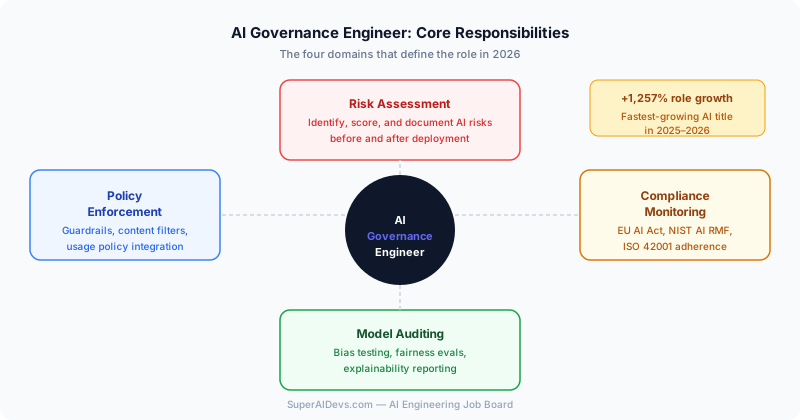
The Four Core Domains
1. Risk Assessment Systematic identification and scoring of AI risks before and during deployment. This involves building risk taxonomies specific to your AI systems, conducting structured pre-deployment reviews, and maintaining living risk registers that are updated as systems evolve. Tools: structured risk frameworks (EU AI Act Annex III, NIST AI RMF), custom evaluation pipelines.
2. Compliance Monitoring Ongoing technical monitoring to ensure deployed AI systems behave consistently with documented commitments — accuracy claims, safety constraints, intended use boundaries. This is where the engineering is most intensive: you're building real-time or near-real-time pipelines that check outputs against defined criteria and surface violations. Tools: LLM-as-judge monitoring, statistical process control, custom dashboard tooling.
3. Model Auditing Retrospective technical audits of AI models for bias, fairness, accuracy, and behavioural consistency. This is the work that happens after deployment and periodically on a scheduled basis. It involves building standardised evaluation datasets that represent the demographic and use case diversity the system encounters, running the model against them, and producing structured reports. Tools: Fairlearn, AIF360, custom eval harnesses, demographic parity analysis.
4. Policy Enforcement Implementing technical guardrails that enforce governance policies in production systems. Content filtering, PII detection and redaction, output disclosure requirements, usage logging for auditability. This is the implementation layer — translating policy requirements into working code. Tools: content filter APIs (OpenAI moderation, Azure Content Safety, custom classifiers), output templating, structured logging.
The Regulatory Landscape You Need to Know
You don't need to be a lawyer. But you do need enough regulatory fluency to translate legal requirements into technical implementations.
EU AI Act (in force) The highest-stakes regulation for companies operating in EU markets. Key technical requirements for high-risk systems: accuracy, robustness and cybersecurity testing; technical documentation before deployment; logging of operation; human oversight mechanisms; transparency to users; post-market monitoring. Understanding which of your systems qualify as "high-risk" under the Act's classification is the first engineering task.
NIST AI Risk Management Framework A US framework for managing AI risk across four functions: Govern (establish accountability), Map (identify risks), Measure (assess risks), Manage (address risks). Not legally binding, but increasingly contractually required and forming the basis for future US AI legislation.
ISO 42001 An international standard for AI management systems, analogous to ISO 27001 for information security. Provides a certifiable framework for AI governance that companies can use to demonstrate due diligence to enterprise customers and regulators. Certification is becoming a procurement requirement in some industries.
Sector-specific regulations Healthcare AI: FDA Software as Medical Device (SaMD) framework, HIPAA implications for AI systems processing PHI. Financial services: model risk management guidance (SR 11-7), fair lending regulations for AI credit decisions. Employment: EEOC AI guidance, New York City Local Law 144 (mandatory bias audits for AI hiring tools).
Skills and Background
The technical foundation:
Python at production level. You're building real monitoring pipelines, evaluation harnesses, and enforcement systems. Not notebooks — production code.
LLM API integration. Most governance tooling involves calling LLMs to evaluate other LLMs (LLM-as-judge). You need fluency with the major APIs and structured output techniques.
Statistical analysis for fairness evaluation. Demographic parity, equalised odds, calibration across groups. You need to understand these concepts and implement them in code, not just reference them by name.
Data pipeline engineering. Governance monitoring systems process large volumes of AI outputs. You need to be comfortable with batch processing, streaming, and the data infrastructure required to operate at scale.
Logging and observability. Governance requires comprehensive audit trails. You need to design logging systems that capture the right information for compliance reporting without creating security or privacy risks.
The non-technical skills that matter more than most candidates expect:
Regulatory reading comprehension. Can you read a regulatory text and identify the specific technical requirements it creates? This is a learnable skill, not a legal degree.
Clear writing. AI governance produces a lot of documentation — risk assessments, audit reports, technical memos for board and legal review. The ability to write clearly for a mixed technical/non-technical audience is often what separates a strong governance engineer from a strong AI engineer.
Cross-functional collaboration. You'll work with legal, compliance, product, data science, and executive stakeholders simultaneously. Managing competing priorities and communicating technical constraints to non-technical stakeholders is core to the job.
What It Pays
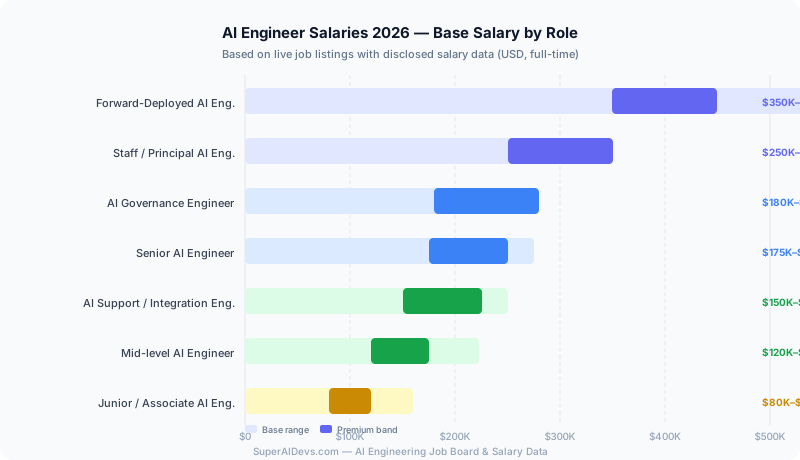
Based on active listings with disclosed compensation:
| Level | Base salary range | |-------|------------------| | Associate / Governance Analyst (0–2 yrs) | $90K–$140K | | Mid-level Governance Engineer (2–4 yrs) | $150K–$220K | | Senior Governance Engineer (4–7 yrs) | $200K–$280K | | Principal / Head of AI Governance | $260K–$380K |
The role commands a meaningful premium over general AI engineering at the same level, for a simple reason: there are very few people who have both the engineering skills to build compliance systems and the regulatory fluency to know what those systems need to do. The intersection of those two skill sets is where the highest pay lives.
Contract and consulting rates for AI governance specialists range from $150–$250/hr, reflecting both the scarcity and the liability reduction companies achieve by getting the compliance work right.
Where the Demand Is Concentrated
Financial services is currently the most active hiring market for AI governance engineers. Banks, asset managers, and insurance companies are deploying AI at significant scale into credit decisioning, fraud detection, and customer interactions — all of which carry regulatory exposure. AI governance engineers here work closely with model risk management teams and are often the technical interface with regulators.
Healthcare and life sciences is the second most active market. FDA oversight of AI-powered medical devices, HIPAA implications of AI systems processing patient data, and liability concerns around clinical decision support are driving demand for engineers who can navigate this intersection.
Large enterprise software companies — Salesforce, ServiceNow, SAP, Workday — are embedding AI into products used by customers in regulated industries. They're hiring governance engineers to make their AI features compatible with their customers' compliance requirements.
AI-native companies are building governance functions as a go-to-market requirement. Enterprise customers increasingly require demonstrated governance practices before signing large contracts. Companies like OpenAI, Anthropic, Cohere, and their competitors are building internal governance engineering teams to produce the documentation, audits, and technical controls that enterprise sales require.
Consulting firms — Deloitte, KPMG, EY, McKinsey — are building AI governance practices to serve clients navigating the EU AI Act and NIST framework. This is typically a higher-pace environment with more variety than an in-house role.
How to Break In
Path 1: From AI/ML engineering If you're already an AI or ML engineer, the transition involves developing regulatory knowledge and compliance context rather than new technical skills. The best way: get involved in your current company's AI governance work (even informally), learn the regulatory frameworks, and look for a role at a company with a more mature governance function where you can develop formal expertise.
Path 2: From software engineering The most reliable path is through a company deploying AI in a regulated industry. Financial services and healthcare companies are particularly likely to hire software engineers who are willing to develop AI governance expertise — the supply of candidates with both engineering skills and regulatory context is low enough that they'll train the engineering side.
Path 3: From compliance or legal technology If you have a background in legal technology, compliance engineering, or risk technology, the transition involves developing AI technical skills rather than compliance context. Python proficiency, LLM API familiarity, and hands-on experience building AI evaluation systems are the priority.
What to study:
- The EU AI Act full text (specifically Articles 9–17 on requirements for high-risk AI systems)
- NIST AI RMF documentation (the core document is publicly available and readable)
- Fairlearn and AIF360 documentation — practical tools for bias evaluation
- ISO 42001 overview materials
What to build: A bias evaluation pipeline that tests a real AI system for demographic parity across a defined characteristic. Run it against a publicly available model and document the findings. This is the portfolio artifact that most directly demonstrates the core technical skill of the role.
The Window Won't Stay Open
The 1,257% growth in role postings reflects a lag between demand and supply — companies are posting these roles because they can't find people to fill them. That lag closes as more engineers develop the right skill combination, as universities create relevant programs, and as the regulatory environment becomes less novel.
If you're an AI engineer looking for a differentiated position in a rapidly growing market, AI governance is one of the clearest opportunities in 2026: high demand, relatively low competition, strong compensation, and the regulatory pressure that creates this demand isn't going away.
Browse AI governance and compliance engineering roles on SuperAIDevs filtered to governance and compliance backgrounds.