If you haven't heard of a forward-deployed AI engineer yet, you will soon. Job postings for this role grew 800% between 2024 and 2026, and it now sits at the very top of the AI engineering compensation ladder — with salaries regularly reaching $350,000 to $450,000 at leading AI companies.
The role is still poorly understood outside of the companies that created it, which means there's a rare window right now where the demand is enormous and the competition is relatively low. This guide covers exactly what forward-deployed AI engineers do, how the role differs from other AI engineering positions, what skills you need, and how to get there.
What Does "Forward-Deployed" Actually Mean?
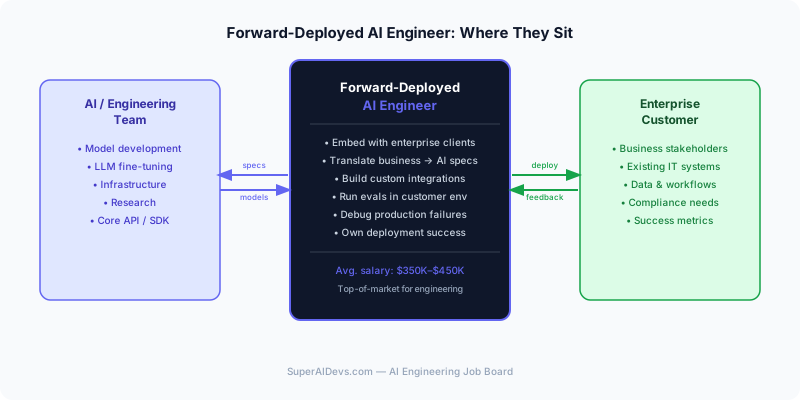
The term comes from military logistics — "forward-deployed" means positioned close to the action, not back at headquarters. In the AI engineering context, it means you're embedded with the customer rather than sitting inside your own company's engineering organisation.
A traditional software engineer builds a product and ships it. A forward-deployed AI engineer takes that product and makes it work inside a specific enterprise customer's environment — integrating it with their existing systems, customising it for their workflows, debugging it in their infrastructure, and owning the outcome of the deployment.
The role was pioneered by companies like Palantir (who called it "Forward Deployed Engineer" and built it into their entire go-to-market model) and has since been adopted by OpenAI, Anthropic, Scale AI, Cohere, and most other major AI companies that sell to enterprise customers.
The Day-to-Day Reality
The job looks different from week to week, but a typical month might involve:
Week 1 — Discovery and scoping You're on-site (or in extended video sessions) with a new enterprise customer — a large financial services firm, a healthcare network, a logistics company. You're talking to their data team, their compliance officer, their head of operations. You're learning their systems: what data they have, where it lives, what format it's in, what their current workflows look like, and what "success" means for this deployment.
Week 2 — Building the integration You're writing Python. You're building the pipeline that takes their data and makes it work with the AI system. You're handling authentication, API rate limits, data formatting, edge cases. You're probably discovering that their data is messier than anyone told you, that one of their systems doesn't have an API and requires scraping, and that the compliance team has requirements that change the architecture.
Week 3 — Running evals in their environment The AI behaves differently on their data than it did in your test environment. You're running your eval suite against real queries from their users. You're debugging why certain document types cause retrieval failures. You're tuning prompts for their specific use case. You're presenting results to stakeholders and managing expectations.
Week 4 — Handoff and productionisation You're documenting everything. You're setting up monitoring so someone can tell when things go wrong. You're training their team to use the system. You're writing the post-deployment review that feeds back into product development. And you're probably already scoping the next engagement.
This is fundamentally a client-facing engineering role. The best FDEs combine deep technical skill with the ability to communicate clearly with non-technical stakeholders, manage ambiguity, and stay calm when things break in production in front of a customer.
How It Differs From Other AI Engineering Roles
| | Forward-Deployed AI Engineer | AI Platform Engineer | AI Integration Engineer | |--|--|--|--| | Where you work | Inside customer environments | Your company's infrastructure | Your company's product team | | Who you talk to | Customer executives + data teams | Internal engineering | Internal product + engineering | | Primary output | Working deployment for this customer | Scalable platform for all customers | Feature integrated into product | | Travel | Frequent (some roles) or intensive remote | Minimal | Minimal | | Comp range | $350K–$450K | $180K–$280K | $150K–$250K | | Growth path | Principal FDE → Solutions Architect → GTM leader | Staff / Principal Engineer | Senior → Staff Engineer |
The key difference is accountability. An AI platform engineer is responsible for the platform. A forward-deployed AI engineer is responsible for whether the customer succeeds. That's a fundamentally different kind of pressure — and it's why the role pays significantly more.
Who Hires Forward-Deployed AI Engineers?
The role is most common at:
AI-native companies selling to enterprise: OpenAI, Anthropic, Cohere, Scale AI, Glean, Harvey (legal AI), Abridge (healthcare AI), Writer, and similar companies. These organisations have complex products that require deep customisation for each customer and can't just ship a SaaS product and let customers figure it out.
Large tech companies with AI enterprise offerings: Microsoft (Copilot deployments), Google (Vertex AI enterprise), AWS (Bedrock enterprise). These teams are distinct from the product engineering organisations — they're specifically the people who make AI work inside a specific customer.
Systems integrators: Accenture, Deloitte, PwC, and McKinsey all have large AI deployment practices. The role here is called different things (AI Solutions Engineer, AI Consultant, AI Implementation Specialist) but the work is similar.
Scale-up tech companies: Any company that has built an AI product and is now selling it to mid-market and enterprise customers is building an FDE function, often without calling it that yet.
The Skills That Get You Hired
Non-negotiables:
- Python at production level. You're building real integrations, not demos. You need to handle errors, write tests, manage dependencies, and produce code that someone else can maintain.
- LLM API integration fluency. You need to be able to use OpenAI, Anthropic, Cohere, or open-source model APIs without looking at the documentation for every call. You understand context windows, token limits, function calling, and structured output.
- RAG pipeline experience. Most enterprise AI deployments involve retrieval over customer documents. You need to have built at least one RAG system from scratch and understand the failure modes.
- System integration experience. REST APIs, data pipelines, authentication flows, database queries. You're connecting AI to existing systems, which means you need to understand how those systems work.
What separates good from great:
- Eval instinct. Can you build a test suite that measures whether the AI is performing well on a customer's actual use case? This is often the first thing a customer asks for and the last thing most candidates think about.
- Communication under pressure. When something breaks during a demo, how do you handle it? When a customer's CTO says "I don't think this is working," can you diagnose the issue in real time, explain it clearly, and propose a fix without losing their confidence?
- Fast architectural judgment. Every customer is different. You need to make good architectural decisions quickly — which approach to use for chunking, which retrieval strategy fits this data type, whether to use function calling or structured prompts. You can't spend two weeks prototyping every option.
- Compliance awareness. Enterprise customers in financial services, healthcare, and law have regulatory requirements that affect how AI can be deployed. You need to understand at least the basics of data residency, PII handling, and audit trail requirements.
The Career Path
Most forward-deployed AI engineers come from one of two backgrounds:
Path 1: Software engineer who went deep on AI 3–5 years as a backend or full-stack engineer, then intentionally built AI systems — RAG pipelines, agent frameworks, LLM integrations — either in a previous role or through serious side projects. The software engineering foundation means you can ship production code; the AI depth means you can actually solve the technical problems.
Path 2: AI/ML engineer who developed client-facing skills Started in a more traditional ML or data engineering role, moved into a role that involved communicating with stakeholders (solutions engineer, ML platform engineer, or internal tools), and developed the combination of AI technical depth and communication skill the role requires.
Compensation progression:
| Level | Base salary | Total comp (with equity) | |-------|------------|--------------------------| | FDE (2–4 years) | $180K–$250K | $250K–$400K | | Senior FDE (4–7 years) | $250K–$350K | $350K–$600K | | Principal FDE / Solutions Architect | $300K–$450K | $500K–$900K |
The equity component is particularly significant at AI-native companies that are pre-IPO. Several FDEs at OpenAI, Anthropic, and Scale AI from the 2022–2024 cohort are looking at multi-million dollar equity outcomes.
How to Break Into the Role
The fastest path is through a solutions or integration engineering role. Companies that are hiring their first or second FDE will often hire from adjacent positions — someone who has been doing AI integration work in a pre-sales or solutions engineering capacity and wants to go deeper technically.
Build a portfolio that demonstrates customer-facing AI work. The portfolio project that resonates most for this role is one where you've taken an AI system and made it work on a specific real-world dataset or use case. Not a tutorial project — a deployment that had to work reliably on non-trivial data with real constraints.
Target AI-native companies that are scaling enterprise sales. The moment a company starts selling to enterprise customers, they start building an FDE function. If you can get into that company before the FDE team exists and demonstrate the ability to do the work, you'll often be the person who defines what the role looks like.
Write about enterprise AI deployment. The FDE community is small and public writing on practical enterprise AI integration is rare. Engineers who have built in public — through blog posts, talks, or open source work — are consistently easier to hire because there's evidence of their thinking and skills before the interview.
If you're looking for forward-deployed AI engineer roles or similar enterprise AI positions, browse current openings on SuperAIDevs — you can filter by stack to find roles that match your specific technical background.